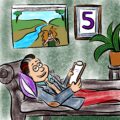
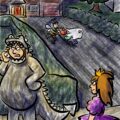
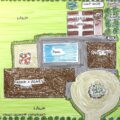
Let’s use this first worldbuilding blog to talk a bit about fake versus real locations and why it’s probably best to stick with fictional places… at least for what I do.
Going back to my first comic, Zamo the Destroyer, it was based in my hometown of Richmond, BC. I lived my whole life up until that point on St. Alban’s Road just a few blocks away from the big mall and city hall, and somehow I felt like the right spot for Georgie and Zamo’s house was a couple doors down from my house on the corner of St. Alban’s and Jones.
(Somehow I felt that Georgie would have a corner lot for a bigger garden.)
I don’t think I ever gave the location away, but that was what it was in my mind, albeit by the time I was doing Zamo most of the houses I grew up by were gone, replaced with low-rise condos and townhouses, while in the comic it was all still single-family houses.
The house itself wasn’t the one I grew up in or the bungalow that the neighbor on that corner lot had. It was a house from the other side of Richmond that my aunt and uncle rented for something like 15 years before the original owner passed on and the owner’s adult kid wanted to move into. My aunt and uncle then bought in Surrey before selling to move back to their hometown in New Brunswick, and I think the kid only lived there for the mandatory “primary residence” year to avoid capital gains taxes before selling it to a developer who knocked it down and built a McMansion on the plot… but that’s beside the point.
When I knew the house it was a charming 1950s split level: slab foundation, small entry foyer at ground level, big rec room with a small snooker table and bar to the left, laundry/powder room straight ahead, small short door to the large crawl space storage to the right and the half-flight of stairs just behind that to the right. The crawl space went all under the next level up, which had a large living room with fireplace, dining room, kitchen with a built-in bench breakfast nook and a door leading out to a little deck with stairs on either side and a clothesline… we’ll talk more about their backyard after. In the corner of the living room by the kitchen the next batch of stairs went up to the top level over the rec room, laundry room, and foyer; this level had 3 bedrooms and a bathroom.
My uncle kept the yard like an immaculate golf green. Mostly grass but with a pear tree and a blueberry bush and a couple assorted shrubs here and there, the yard also boasted a detached double garage with workshop and shed in behind where he worked on cars as a hobby and side hustle. They also had a large square patio next to the garage and across from the kitchen deck that was roomed in with two walls of breeze block painted white. Meanwhile, the asphalt driveway got a fresh coat of black sealer every summer.
When I envisioned Georgie and Zamo’s house, that was the place: the rec room became Georgie’s painting studio, Zamo claimed the crawlspace for her “secret basement lab” and of course Zamo had her own bedroom upstairs as well.
I simply transplanted that house to the corner lot on my block and added a higher cedar fence, removed the breezeway block patio (much as I loved it in reality) and swapped the grass for a full-yard veggie garden based on the one another aunt and uncle had in Winnipeg for as long as I could remember.
When I moved from Richmond to Vancouver Island in 2017, Zamo had become a podcast instead of a comic, and for some reason I just couldn’t leave well enough alone, so I had a plot wherein Georgie and Zamo (and eventually all the other characters) also moved to the Island, albeit it in different parts: the Churchmans bought a small homestead/farm up north close to Port Hardy, Georgie bought a house in Metchosin, Technical Support Monkey (aka me) moved to the Cowichan Valley with Mr. Hydell conveniently turning up a block away, Wilhelm in Ladysmith, etc.
I thought it was easier this way because I wouldn’t have to care about keeping tabs on what was going on in Richmond, especially as Zamo complained a lot about weather and for some reason I thought it needed to be accurate.
But the whole thing was rather contrived. For example: my brother moved to Alberta a few years ago. Only in the last couple weeks did he find out that a couple of his old friends from Vancouver also move there – one lives in a town 15 minutes from him, another an hour or so away. One just moved, the other turned out to have moved there before he did but they’d lost touch so he didn’t know.
Etc.
That’s how it goes in the real world.
As opposed to how I did the moving plot in Zamo with the whole gang moving around the same time.
You could kinda see Georgie, the Churchmans, and Mr. Hydell moving all at once, as they were neighbors and “land assembly” sales are a thing, but then Wilhelm lived in an apartment several blocks away and Georgie’s parents lived about 15 minutes away, etc.
And why would they mostly all end up within a 30 minute drive of each other on the Island? I mean, I guess sometimes it’s plausible that family members might do that, as my dad and I moved from the same house in Richmond to two houses a 20 minute drive apart, but that would seem to be the exception, not the rule. Especially when adding neighbors and friends into the mix.
And then we had issues where I ended up making a lot of Zamo plots about the move and real estate and… well, I guess I ran out of things to write about until the lockdowns of 2020, but the podcast still fizzled by 2022.
It would have been far better to keep the whole gang in Richmond even though I wasn’t there.
And as for the “keeping things accurate”: 1. No one cares. 2. This is an argument for a fictional town where no one can debate accuracy, not for moving the cast to wherever I lived.
It’s not like there wasn’t precedence for the fictional place angle in Zamo; Zamo claimed to be a professor/anthropologist working on research for a post-doctoral thesis from the Iguanid University of the Jungle back home in Colombia.
My next two projects split on the real/fake divide. The Nick White Show was intended as a cultural (and, to a lesser extent, political) satire, and it was conceived in the midst of the lockdowns. By that time, the shine of my new home on Vancouver Island had worn off and I had started to despise the Karen culture there. It also seemed Canada was headed towards becoming a new Venezuela.
And so Nick’s home was loosely based on Victoria, BC, but that town of Karens was named “Carrington” and the country “Canazuela.”
Mention was made of real places like Brian Adams’ studio in Vancouver, and I have a strong mental picture of exactly what street in Victoria Nick’s studio is located on, and what golf courses Nick’s father hangs out at and which mansion Nick lives in, but I avoided making it too fixed in real places… after all, the goal was “fake, but accurate.”
Noah’s Archipelago is officially located in Oak Bay, a wealthy part of Victoria, with Noah, Ruth, and their two daughters living in the guesthouse of Ruth’s parents’ property, but I do sometimes think I should have made it a fictional location instead.
(The property itself is fictional and I suppose is probably closer to the huge estates I used to drive by on my way to the University of British Columbia along Southwest Marine Drive in Vancouver than anything I’ve driven by in Oak Bay.)
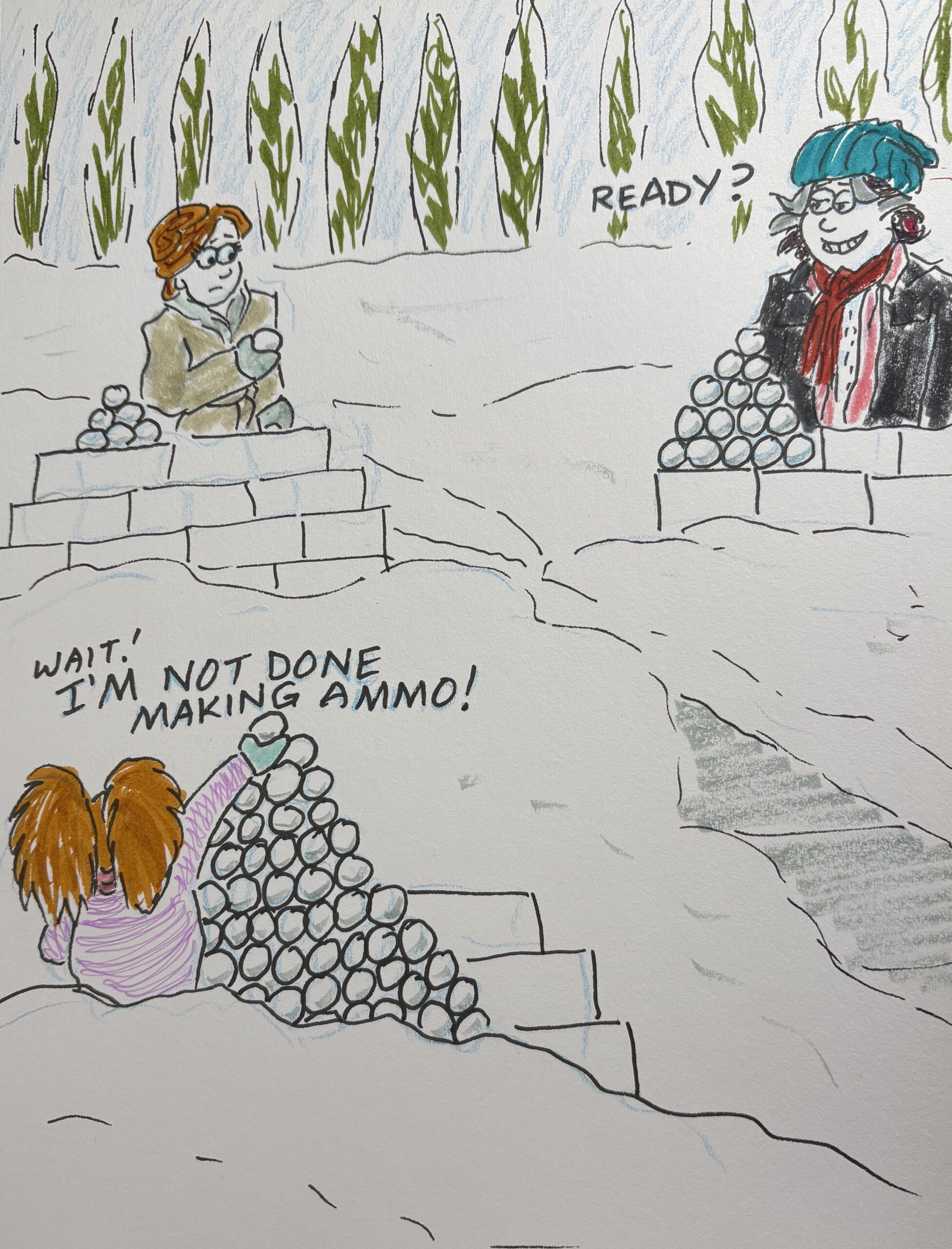
Of course, the first book is coming out in 2 weeks and straight up mentions Victoria and Oak Bay, so I’ll leave it because I really can’t be bothered to make adjustments now, but in many ways it’s already a fictional version of Victoria just on account of the frequent waist-deep January snow that appears in Noah’s Archipelago but never in the real Oak Bay:
At some point, I plan to leave Vancouver Island far behind and I’ll probably join my brother in Alberta, but, having learned my lesson from Zamo, I think I will let the Thorsens et al stay in Victoria.
Besides, I’m starting to write stories and have projects where my various characters from different projects and places are coming together and turn out to live around the corner from each other in ways that make no sense outside of these combo stories.
For example, Ricky and his crew all live in Ratsville in the state of Ratland, one of the United States of Cheese… which is not the same as the United States of America and there’s some debate as to who pilfered the name from who as both the USC and the USA were founded around 250 years ago. (Ricky will need to explain this all to us at some point… assuming he was awake enough in geography class to know the answer.)
However, in the beginning of 2026 we had a series of Noah comics in which Ursula went to hang out with Ricky and Ricky’s mom refers to her as “the neighbor girl”…
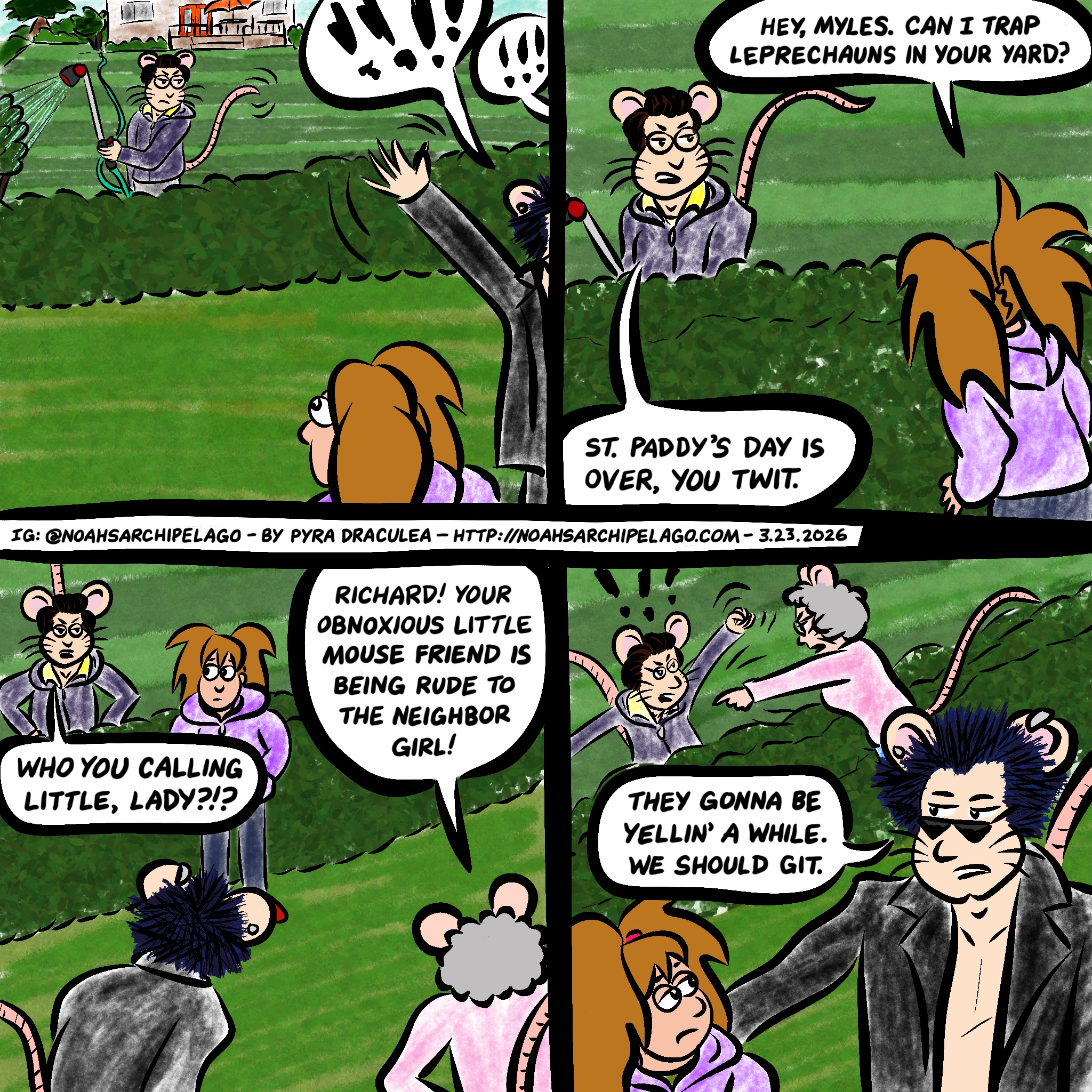
… while Noah seems quite unaware that there are giant talking rat-people, period, let alone living in his neighborhood.
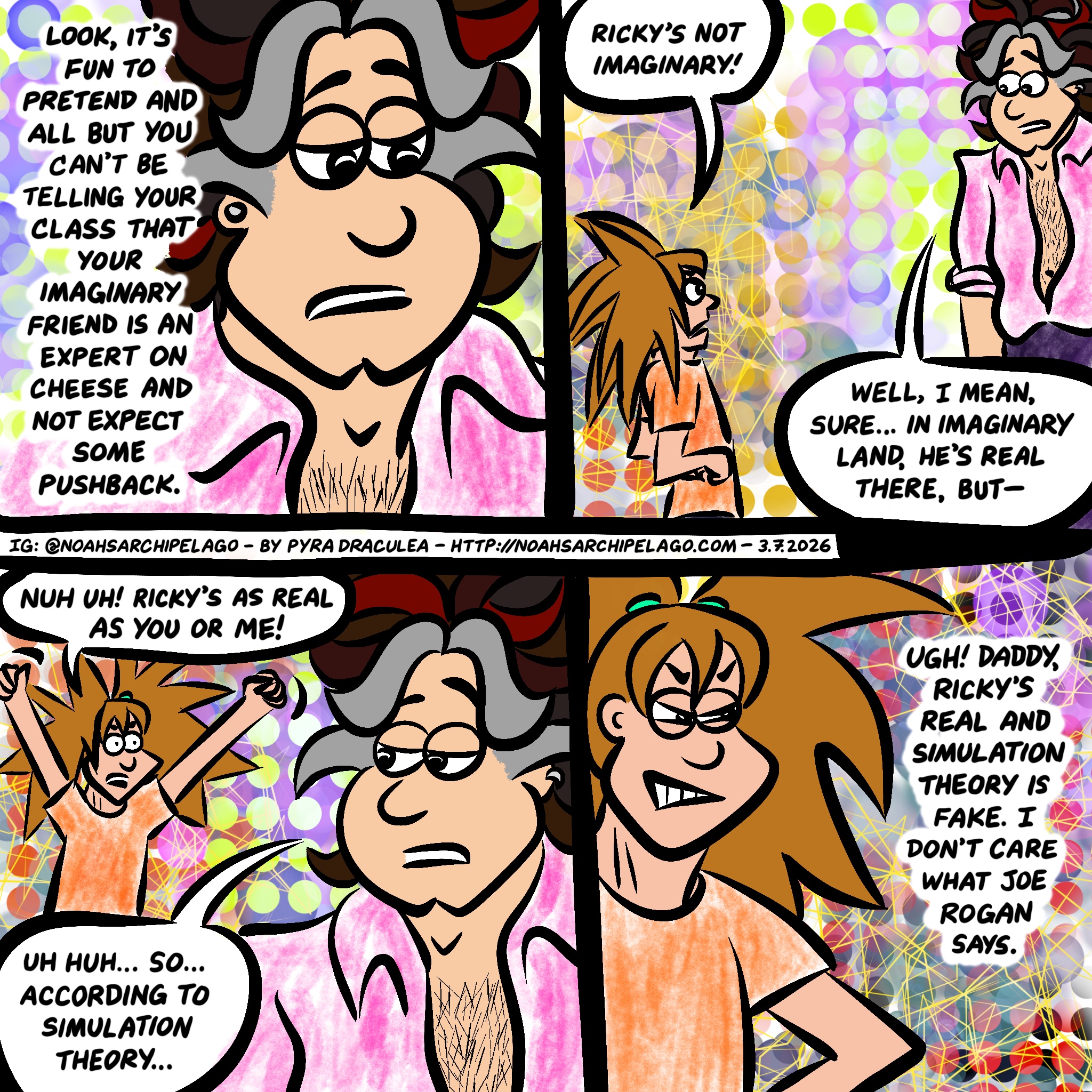
This will shift in some future stories where Noah is part of adventures involving the rats, though I may leave it as an open question as to whether these things are really real or just part of Ursula’s imagination or maybe they’re real but in a parallel dimension that Ursula can access but not generally apparently or accessible unless Ursula is involved… I dunno, yet.
But what I do know is the advantage of a Ratsville or a Carrington (fake locations but in the real world) is that it seems to be the best of both worlds: you can base it on somewhere real and situate it in the real world, but you also can make it whatever you want because it’s not beholden to the real world.
Flexible, ya know?
Anyway, there’s a few scattered thoughts on locations.
To keep on top of new releases and other news from Pyra, sign up for her weekly newsletter:

Pyra Draculea is a Canadian cartoonist and author based on Vancouver Island who has been drawing weird little characters and making up elaborate storyworlds in her head for as long as she can remember. Her work is boldly colorful and often darkly humorous, incorporating major themes of celebrity culture and rock’n’roll nostalgia as well as the three Fs of fandom, façades, and fantasy lives.
Her first book, Bring Me the Royal Flip-Flops: A Noah’s Archipelago Comics Treasury, was released in October 2026 and is available on Amazon.